

by Paul Broadhurst
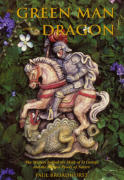
What are the links between the Knights Templar,What Lies behind the mask of St George? Most modern researchers believe he never existed as a historical character, and yet he is still revered throughout the world as an inspirational guide and spiritual power.
The truth is that he is far older than we might imagine, pre-dating Christianity by many thousands of years. He has powerful links with the enigmatic Green Man and also the Knights Templar who understood the mystical traditions of those former times.
Is he really an ancient God of the Earth from the very beginnings of time?
This quest to discover the real St George leads to Ancient Egypt, the Holy Land, the megalithic temples of Britain and Ireland and the churches and cathedrals of Europe. It is the story of human evolution from the earliest times, and includes the rediscovery of a science of the forces of Nature, symbolised by the Dragon.
Within this book is a key to discovering the principles that guided ancient religions and civilisations across the world, and the power of self-transformation that comes with a true understanding of the Mystery behind the Myth.
This new book published on St George's Day 2006 completely rewrites the accepted version of the history of St George. In The Green Man and the Dragon, author Paul Broadhurst shows that St George was not the Roman soldier martyred for his beliefs but a prehistoric god of fertility adopted by the early Christian Church.
As a mythologist and researcher into ancient mysteries, Mr Broadhurst has spent a number of years travelling across Europe and Egypt and has unravelled what he says is "a story of how a primeval god was absorbed by early Christianity so that pagan beliefs were incorporated into the new religion." He goes on to explain that this knowledge was understood by the mystical Knights Templar, who became a powerful force in the medieval world and adopted St George as their patron saint.
He comments "The facts are that Constantine the Great, who created Christianity as we know it, was desperate to keep the crumbling Roman Empire together and was obliged to adapt many of the pre-Christian belief systems to make the new religion work. You can tell that George was a god of the earth through the etymology of his name, which contains the component Ge not once but twice. This is one of the oldest words for the earth known, going back to Egyptian and Sumerian times, over 5000 years ago. We still use it today in words such as Geography, Geology and many other sciences to do with studying the planet."
"Another clue is that St George is the central figure in the old springtime folk rituals like Padstow in Cornwall, celebrating the renewed fertility of the coming summer season. This is true throughout Europe and the Middle East, where he is known as Green George. He personifies the fertile principle in nature, and can be equated with the Green Man of early folklore, whose image can be seen in thousands of churches and cathedrals whose designs were inspired by the Templars."
"This is why people love St George, even though he has become entangled with certain nationalistic elements today. He is in fact a universal god of the earth who reminds us of our dependence on the forces of nature."
"The Green Man and the Dragon is bound to cause controversy, especially within the more orthodox echelons of academia and religious philosophy. Christianity performed a remarkably effective hatchet-job on the old pagan gods, first absorbing them and then often demonising them. They couldn't to this with St George because he was so popular. But in 1968 the Vatican finally de-listed him as a universal saint, thereby saying more or less "we've finished with him now because no-one can remember where he really came from." Centuries of propaganda had eventually worked. The Roman Church exterminated the Knights Templar in 1307 because they challenged the might of the Vatican, and now they have finally tried to kill off St George. But the strange thing is that people still look to him as a spiritual guide who stands for truth and justice. His power is still very much alive."
And what of the dragon? Mr Broadhurst, the author of a number of books on mythology and dragon-lore, claims that the dragon was a symbol for the powers of the natural world. "It is clear that all pre-Christian religions worshipped the dragon, for it represented the spirit of nature" he says. The dragon or the winged serpent was central to the religion of both the Celts and the Egyptians. The medieval Church, in an attempt to destroy the last vestiges of pagan religion did their best to make it a symbol of evil.
"Yet there is far more to this story than the simplistic interpretation of the Christian St George representing the forces of good slaying the dragon of evil. The truth is that the political propaganda was very effective, but everyone knows there is something deeper going on. Why else do we still admire St George and everything he stands for?"
What reviewers said:'One of the most eloquent and knowledgeable writers in the earth mysteries field… an extraordinary book.'
Martin Gray, Sacred Sites.com
'Simply one of the most beautiful books I have had the pleasure to read... the book’s contents are informative and concise and demonstrate the emergence of the St George and Dragon story from much earlier sources... thoroughly recommended.'
Andrew Collins
'This is a well-written, thought-provoking and beautifully-produced book... a fascinating addition to the burgeoning literature about the Green Man.'
Merry Meet Magazine
'This book sets out to reclaim St George from English nationalism and to explore his links with the Green Man and the Knights Templar. It ranges widely over legend and history, examining the myths of giants, green men, pagan gods, dragons, Druids and serpents. Paul Broadhurst knows his material well and weaves together many seemingly disparate threads to produce an intriguing book.'
Meyn Mamvro Magazine
Contents include: Green Roots, Green Shoots, A Legend Obscured, Lord of Sun and Earth, Green George, The Name of the God, The Mystic Way of St George, St George and the Mysteries of Albion, The Assembly of the Wondrous Head, Message from the Templars, The Dragon Power, Heavenly Treasures, The Dragon of Revelation, A Search in Secret Egypt, The Green God of the Nile, The Art of Dragon Taming, Return of the Dragon Slayers, The Spear of Light, The Alchemical Wedding, Harvest of Souls, Thanksgiving.
Available in paperback and hardback editions, both finely-produced in the classic Mythos style.
224 pages printed sepia on cream paper, beautifully illustrated, plus 8-page colour section.
Hardback (ISBN No. 0-9513236-7-9); Limited Edition of 1000 copies, signed and numbered.
Full colour dust jacket, £18.95 plus £4.60 pp.
(Airmail Europe extra £7.00, U.S. £11.00)
Paperback (ISBN No. 0-9513236-6-0); Similar style as above, £12.95 plus £2.70 pp
(Airmail Europe extra £5.25, U.S. £8.25)

by Paul Broadhurst and Hamish Miller
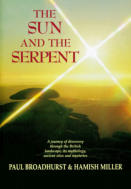
In the late 1980s two researchers into ancient mysteries began a remarkable journey of discovery across southern Britain. Their quest began at St Michael's Mount, and led them to Glastonbury, Avebury and the east coast, and included a great number of ancient sites, some famous and many that had almost been forgotten. Their discoveries as they travelled along the St Michael Line, a countrywide alignment of sites dedicated to St Michael, have deep implications for our understanding of why these places have been so important in previous ages, and why so many people are drawn to visit them today. This account of their adventures and discoveries, written by researcher and photographer Paul Broadhurst, details their quest for a rediscovery of the forces of Nature that create the 'spirit of place'. With maps and plans by dowser Hamish Miller, this book provokes a realisation that in former times, the Earth was understood to be a living being whose powers were considered sacred.
What reviewers said:
'The Sun and the Serpent is one of the strangest, most stirring books I have ever read, and it may prove through its implications to be one of the most important. For if the authors are correct in what they affirm, they have uncovered in the English landscape the most remarkable of ancient secrets'
John Michell
'This book delights and excites; once I'd begun the journey I truly couldn't put the book down'
Resurgence
'A living text book on the earth energies our ancestors understood'
New Dimensions
'If we are followers of the Gaia hypothesis in which the Earth is a living being with which we must live in harmony, this is an important work. I urge you to read it and decide for yourselves.
Sir Charles Jessel, President, British Society of Dowsers
216 page paperback (ISBN No. 0-95151-831-3), over 80 maps and illustrations,
plus 8 page colour section £12.95 plus £4.60 pp
(Airmail Europe extra £5.25, U.S. extra £8.25)

by Paul Broadhurst and Hamish Miller
with Vivienne Shanley and Ba Russell
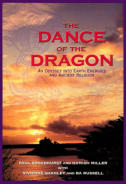
The Apollo/St Michael axis is a remarkable alignment of sacred sites stretching from Ireland, through Cornwall, France, Italy, Greece and Israel, marked by sanctuaries dedicated to the Archangel Michael and Apollo, the Greek God of Light. Over ten years, the authors travel the length of this 2,500 mile axis exploring the significance of earth energies in the siting of these sanctuaries. Rediscovered in this book is a profound principle that takes us back to the very roots of religion, encoded in legend and myth. This demonstrates that earth energies were once at the core of a highly developed Natural Science responsible for determining the position and character of ancient sites.
From an article published in the UK magazine Kindred Spirit:
"Throughout the ancient world the most widespread means of communication with the spiritual realms was achieved through dreams. Whether in deep sleep, or that hypnogogic trance-like state between waking and sleeping, it was known and understood that dreams were a means of directly accessing spiritual truths that could otherwise never be known by the rational mind. For this reason, the dream-oracles of antiquity were many, varied and of enormous significance.
Caves, cracks or fissures in the living rock, holy wells and other natural features where the earth energies are strong were all hallowed by thousands of years of use as centres where people could experience direct knowledge of the unseen. They were places where, quite literally, the Earth spoke. It may be no coincidence, then, that a dream was the starting point for a project that has, over the last ten years, led us to some of the most remarkable oracular sites of Europe.
The dream in question was experienced by the French researcher Jean Richer, who, whilst living in Greece, experienced a vivid nocturnal vision that gave him a clue to the questions that tantalised him: Why were Temple and Oracle sites often located in such inaccessible places, far from human habitation? Why did he feel there to be some profound but inscrutable link between them?
The answer to these deeply perplexing questions came in a sudden revelation. Half-awake, he saw a statue of Apollo turning towards him as if to indicate a direct connection between the Greek Sun God and his main sanctuary at Delphi, and Athens, where Richer was living. He immediately awoke, and, grabbing a guide book lying on his bedside table, drew a straight line from Delphi to Athens. He was amazed to find that this line continued directly to the isle of Delos, the legendary site of Apollo's birth. The line also passed through Kamiros on Rhodes, the site of the oldest temple of Apollo on the island. Richer had discovered, in an intuitive flash whilst in the dream-state, that these sanctuaries were all in direct alignment with one another. Perhaps it was no coincidence either that he was at the time living on Mount Lycabettos, overlooking the Parthenon on the Athens acropolis. The Parthenon was the foremost Athena site of Ancient Greece, and Lycabettos had, in antiquity, been sacred to the Earth Goddess Gaia.
Richer spent many years exploring the significance of his discovery and eventually, in his book Sacred Geography of the Ancient Greeks (now available in an English translation by Christine Rhone, published by the University of New York Press 1994) detailed his many years of work. He claimed that the Greek landscape was divided into astrological segments centred on various important sanctuaries, and that temples were frequently located to mark these divisions. The Delos-Athens-Delphi line that gave him the first clue to this revelation was, he found, one of the main axes of a zodiac whose hub was at Delphi, the centre of the ancient Greek world. This alignment of Temple sites was characterised by the shining figure of Apollo, who had been born on Delos and later located his main sanctuary at Delphi.
A further, and even more remarkable development was when Jean Richer's brother, Lucien, discovered that if this 'Apollo' line was projected outside the confines of Greece, it led to a chain of other sanctuaries across Europe. Using a Mercator projection of the globe, which takes into account the spherical geometry of the Earth, he found that the original Apollo Line passed through some of the most notable sites of pre-Christian times. These had once been dedicated to ancient Sun Gods and the Earth Goddess, whose traditions had been absorbed into early Christianity. Legends and accounts of their subsequent rededication tell of a series of miraculous visions of a luminous being hovering above rocky, mountainous outcrops or appearing in dreams, instructing that a church or chapel be built at that very spot. The visions were reported as being of St Michael, the Archangel of Light and the Cosmic Being charged with human evolution.
This new dimension to Jean Richer's original discovery has considerable implications for the study of ancient science and the knowledge that originally determined the precise location for such significant sites, so closely linked to the changing patterns of religion and spirituality through the ages. Underlying this revelation is the fact that all these places are thus related to each other, and form an axis that suggests a profound principle of earthly existence, once understood by ancient priesthoods but long banished to the twilight world of ancient spiritual science. At an angle of virtually 60 degrees west of north, this 'Apollo/St Michael axis' links the major St Michael sites of Europe with the Apollonian centres of Greek tradition, providing a unifying principle behind both Christian and pagan religions. The main sanctuaries located on this axis are, from the north-west to the south-east:
Skellig Michael, eight miles off the Atlantic coast of south-western Ireland, where an impressive Celtic Christian monastery of beehive huts still survives in one of the most remote and storm-lashed locations imaginable.
St Michael's Mount, Cornwall, a place once inhabited by a legendary giant, and a centre of former Druid Sun-worship, where a glowing vision of St Michael was reported by local fishermen sometime around the 5th century. In medieval times the Mount became an important pilgrimage centre where miraculous healings were commonly observed.
Mont St Michel, just off the coast of Normandy, a place where, according to Druidic tradition, another earth-giant once lived. Its foundation as a place dedicated to St Michael was brought about by the Archangel who appeared in a dream to a local bishop, St Aubert, touching him on the forehead and making a hole in his skull to emphasise the reality of the encounter.
Sacra di San Michele in the Italian Alps, a formidable monastery perched on the summit of a mountain guarding the natural route from Italy into France. Again, a vision of St Michael appeared and instructed that a chapel be built in his honour, which grew to become one of the greatest sanctuaries in the region.
Monte Sant' Angelo on the Gargano peninsula of Italy, one of the greatest of all the St Michael shrines, where he was reputed to have personally consecrated a cave deep in the mountain, formerly a dream-oracle to the Earth Goddess. Situated on a main route to the Holy Land, it was an important stopping-off point for Crusaders and had been famous throughout Europe as possessing a unique property; in the cave was a chasm into which, according to tradition, all the sins of mankind could be cast.
Delphi, the site of Apollo's main sanctuary on the slopes of Mount Parnassus in Greece. Formerly an Oracle to the Earth Goddess, it was here that according to legend the Sun God slew the serpent guardian of the shrine with golden arrows. Believed by the ancients to have been the centre of the world, an Omphalos stone marked the place of the navel of the Earth Goddess.
Athens, with its famous Acropolis dedicated to the Goddess Athena now dominated by the ruined Parthenon. A prehistoric site of great antiquity and spiritual significance, the hill is studded with remains of earlier temples and caves, including one dedicated to Apollo. Still surviving is a Temple to Erichthonios, a half-human, half-serpent godlike being who became the first King of Athens.
Delos, a small island at the centre of the Cyclades, renowned as the birthplace of Apollo. Tethered to the sea floor by Poseidon, it provided refuge for Apollo's mother Leto who travelled the Earth in search of a place to give birth to the Sun God. So sacred that in later times no birth or death was allowed on its soil, it became a place of enormous influence throughout the Mediterranean.
This alignment of ancient sanctuaries dedicated to the Christian and Greek personifications of Light cannot fail to intrigue modern minds and compel us to wonder what such an extraordinary phenomenon could possibly mean. The mystery is deepened further when it is realised that beyond Greece, the line extends to Mount Carmel in the Holy Land, the place where according to Biblical accounts, the Hebrew God Yahweh supplanted the God Baal during a magical battle between the pagan priests and the prophet Elijah.
It seems that this corridor of primordial sites (which significantly includes many other important places marked on the accompanying map) has had a profound influence on the currents of human evolution that have manifested in successive ages. It appears as a channel of spiritual energies determined by Nature itself. But what of Apollo and St Michael?
The similarities suggest that they are in reality different versions of the same archetypal force, symbolised by the Greek Sun God and the Christian Angel of Light. Exploring this idea provides us with further clues to the enigma that leads us to a deeper understanding of this most intriguing of mysteries. (Continued...)
What reviewers said:
'A tremendously exciting book, this must surely be the most remarkable antiquarian or questing journey that has ever been undertaken'
John Michell
The romance of this extraordinary journey so permeates every page that the reader is drawn, exquisitely and irrevocably onwards, as if on the crest of a wave. And yet, having travelled so far, the dazzling nature of each revelation emerges to underscore the romance, and at the journey's end I wanted to start all over again... To have started from Skellig Michael off the coast of Ireland and to have ended up at Armageddon is no mean feat and ten years of labour have flowered into a beautiful, sometimes lonely, oftimes revealing, pilgrimage of the hidden and, for so long, now, neglected pathways of the Earth.
David Elkington
378 page paperback (ISBN No. 0 9515183 5 6), fully illustrated, plus 8 page colour section, £18.50 plus £6.21 pp
(Airmail Europe extra £9.45, U. S. extra £14.85)
A few copies of the original signed, numbered limited casebound edition (ISBN No. 0 9515183 4 8)
currently available at £28 plus £6.21 pp
(Airmail Europe extra £9.45, U.S. extra £14.85)

by Paul Broadhurst
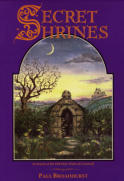
This was Paul Broadhurst's first book, recognised as a beautifully-produced classic work on the phenomenon of sacred springs. The style of its production, with over 20 full colour plates inserted by hand, led author Colin Wilson to write 'Words and images can never capture the truly magical mode of existence, but they can acknowledge its reality. The words and images that follow are an acknowledgement of this reality'.
Secret Shrines is a fascinating journey through the past and into the present which examines the magical and mystical virtues associated with these anciently sacred springs, and the reasons for their undiminished reputation throughout thousands of years of human history. For these places are truly timeless, and the natural springs which bubble from beneath the surface of the earth have always been held holy, famous for their miraculous healings and powers of prophecy and as thresholds to other realms. Dim memories of their old importance still hang like a haze around them, in half-forgotten legends and country tales.
Included in the book is an entertaining and informative ramble around the still remote land of Cornwall in search of the old wells and remnants of their ancient sanctity, often just a crumbling ruin, dripping with moss and ferns and penetrated by the gnarled roots of twisted trees. Others are still famous for their magical properties, and boast impressive Gothic-style buildings to remind us of their former significance, while some exist simply as a roadside spring, their waters ignored and neglected.
Yet the resurgence of interest in these places seems to be a reflection of something deeper than fascinating antiquarianism. Perhaps it is more an attempt to experience the planet as a living being in the same way that our ancestors did for such great ages of human evolution. A recognition that the Earth is indeed alive, and that the health, prosperity and future prospects of everything that lives upon it depends on an acknowledgement of this ancient Law.
What reviewers said:
'This book, written with energy and insight and illustrated with fine colour photographs, will affect the minds of everyone who even looks at it'
John Michell
'Beautifully written, superbly illustrated, a work to delight not only the keen gaze of future antiquarians, but also those seeking to explore unknown territory. It is a long time since a book of such rare quality has been produced in Cornwall.
James Mildren, Western Morning News
'This book is not only a remarkable addition to our knowledge of the beauty and spirituality of the wells themselves but of our understanding of the Earth's mysteries'
Resurgence
'Secret Shrines is a sumptuous book, with beautiful photographs and writing, loving put together with original illustrations and atmospheric engravings. But it is more than just a glossy guide to the wells; it is written with a deep insight into the interconnectedness of all the planet's sacred places'
Meyn Mamvro
Large format paperback (ISBN 0 9515 183 2 1), sepia on cream paper, black-and-white
photographs and engravings, over 20 colour plates tipped-in by hand.
Price £22.50 plus £2.70 pp
(Airmail Europe extra £5.25, U.S. £8.25)

by Paul Broadhurst
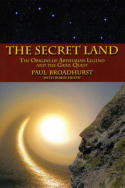
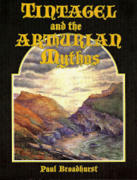
On a dramatic rocky headland of the North Cornish coast stands Tintagel Island. Until recent times isolated and inaccessible, its legendary fame as an ancient royal citadel has spread across the centuries to be celebrated in folklore, mythology and a wealth of literature. Medieval romance recalls it as the place which gave birth to the Arthurian cycle, with its heroic figures, questing knights and the search for the Holy Grail. Even today, it exerts a fascination that many people find irresistible.
Why should a remote spot like Tintagel have created such a unique place for itself in the annals of Britain's magical heritage? Why, in popular tradition, was it the birthplace of King Arthur, where certain rocks. Caves and other features are indissolubly linked with the legend of Arthur and the sorcerer, Merlin?
Tintagel and the Arthurian Mythos penetrates deeply into this mystery. It reveals that the significance of this rocky islet and its fame as a royal and mystical centre is rooted in an understanding that has been lost as successive ages have become more remote from nature. Its importance has been perpetuated in legends that have been the inspiration behind medieval and Victorian revivals, and which are now again being recognised as having an archetypal power to touch and transform human minds.
'This beautifully printed, superbly illustrated book is more than a collector's item: it is a compelling narrative that is also a kind of detective story. There is no doubt in my mind that it will take its place among the classic works on King Arthur.'
Colin Wilson
Paperback 204 pages (ISBN 09515183 9 9), printed sepia on cream paper, colour section.
Price £16.95 plus £2.52 pp
(Airmail Europe extra £4.90 U.S. £7.70)
All rights resereved. No part of this webpage content may be reproduced or transmitted in any form or by any means, electronic, mechanical, presentational including photocopying, recording, or by any information storage or retrieval system, without written permission from the publisher.
© Paul Proadhurst 2006